
Until today, a major rule change in NCAA football for 2013 had gotten curiously little publicity, even though the season’s official kickoff is little more than a month away.
The new rule concerns player safety and more particularly, “targeting” offensive players above the shoulders. Even casual fans of college football must be aware of the changes in recent seasons, as player-safety concerns have proliferated in the wake of new scientific findings showing that head traumas in football are far more numerous and damaging than once thought. Last year, there were several instances of defensive players being penalized or ejected due to their hitting offensive players in the head (and often times, just close to the head). To make matters worse, there didn’t appear to be any uniform standard governing the penalization of players. Yes, there was language in the rule book, but the ultimate decision really turns on the judgment of the game officials. Too often, the officials erred on the side of the offensive player, using a pretty expansive understanding of a head-to-head collision, as well as penalizing defenders when the offensive player bore the greater responsibility for creating a helmet-to-helmet situation.
In any event there was an absolute lack of consistency from game to game and week to week in the application of the rule, although it was very clear that the NCAA has made such contact a point of emphasis for officials. In one notable instance, the University of South Carolina’s safety D.J. Swearinger collected personal fouls on back-to-back plays against the University of Arkansas, the latter play being ruled a helmet-to-helmet blow. The major difference for 2013 is the penalty associated with such an infraction. If Swearinger had made his helmet-to-helmet hit in 2013, not only would the opponent gain 15 penalty yards (as was the case in 2012), but Swearinger would have been ejected for the rest of the game, as well as the first half of the following game.
How is this important? Consider Swearinger’s situation in that Arkansas game: after the second personal foul, on the very next snap Swearinger intercepted Arkansas QB Tyler Wilson’s pass and returned it for a 69-yard touchdown, effectively putting the game away for USC. Clearly, ejecting Swearinger would have had a material impact on the game. On top of that, he would have missed the first half of the following week’s game. Additionally, fans would have been robbed of a signature moment.
Stop Clowneying Around
The new rules were approved as long ago as February, but didn’t receive much notice until today, when the head of officials in the Atlantic Coast Conference tried to apply the new rule to one of the most notable plays of the 2012 season – South Carolina defensive end Jadeveon Clowney’s hit on the University of Michigan running back Vincent Smith in last season’s Outbowl Bowl. If you missed the play – and given the number of times it’s been replayed, tweeted, and posterized, I find it hard to believe that any football fan missed it – Clowney clobbered Smith just as Smith received a hand-off behind the line of scrimmage, separating Smith from the football and sending his helmet rocketing off his head.
The play was an immediate sensation. Replays on You Tube racked up millions of views, and Clowney received a 2012 ESPY award for Best Play; however, according to ACC officiating supervisor Doug Rhoads, he would have flagged Clowney for “targeting,” meaning Clowney would have been ejected from the game.
The play, aside from its stunning visual impact, was also the turning point in the contest, a hard-fought 31-25 victory for South Carolina. It is hard to imagine what would have transpired had the 2013 rules been in effect and Clowney had been ejected, but it’s no question that the game’s result would have been greatly altered, all on a play where it’s not at all clear that Clowney made contact with Smith “above the shoulders.” Slow-motion replays of the play appear to indicate that the point of impact was the chest region, not the head. In effect, Clowney would have been penalized simply for hitting the opposing player too hard.
Reaction to Rhodes’ comments was swift and weighted mostly toward derision, making national news and being the subject of endless debate on sports talk shows around the country. But whether you agree or disagree, the fact is that this new rule change has elevated the role of game officials to an even greater degree. Now, based purely on what is a judgment call, a player can be disqualified from a game (and part of the next game).
Official Mischief
In using the Clowney hit as a case example, Rhodes unwittingly reveals my main complaint with the new rules. Consider how the Clowney play ever came to be: on the preceding play – a 4th-and-1 situation – Michigan seemed to have come up short of the necessary yardage to retain possession of the football, but the play was close enough to warrant a measurement, something with which all football fans are well acquainted. The “chains” are brought out onto the field to the “spot” where the ball was placed at the end of the play. An official looks at the yardage stick, looks at the ball, and then determines whether the nose of the football reached the stick. It is one of the most uncomplicated calls officials make in football, and it is never screwed up. They might “spot” the ball in the wrong place, but the chain measurement is never screwed up. Except this time it was. The television cameras clearly showed that Michigan was short of the stick; however, the official inexplicably awarded the ball to Michigan.
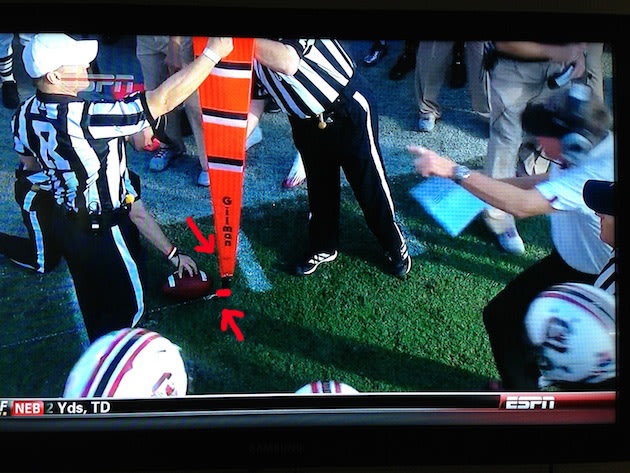
“Well you know what, I asked one of those other refs there, I said, ‘You know the ball did not touch the first down marker.’ He said, ‘I know it didn’t.’ I said, ‘Well, why’d you give it to him,’ and he said, ‘I don’t know.’ That’s what he said.”It is ironic that the Clowney hit would have never taken place had the officials not screwed up the simplest determination in refereeing a football game! If game officials cannot even get this right, do we really expect them to apply the new rules in the correct manner? Do we really expect officials to correctly determine the location of lightning-quick tackles – let alone player intent – during the normal course of a game? The answer is obvious to anyone who has watched football. When you factor in the apparent certainty that officials will err on the side of “safety,” enforcement of the new rule will radically alter the game.
A Lawyer’s Notion of Safety
I gasped in horror last year as the officials’ new-found zeal for penalizing helmet-to-helmet contact yielded some truly bizarre calls. Later in season, I began to sense that offensive players had cottoned on to the new normal and were actually instigating helmet contact by crouching into oncoming defensemen. After all, when a defensive player targets the chest or hips and the offensive player lowers his body, contact with the helmet is practically inevitable. People who have played the game understand this, and there are at least six former players (and current coaches) on the NCAA football rules committee. How did this happen?
It seems pretty obvious that the driving forces behind the rules change had little to do with the practical realities of football and everything to do with the NCAA’s potential legal liability. Given the new science highlighting the hazards of head trauma, the NCAA has put in place rules changes meant to shield member schools from future litigation. In doing so, the game that finances much of member schools’ athletic budgets is being changed forever.
The NCAA may think it is having its cake (player safety) and eating it too (the incredible popularity of college football), but you can’t make football something it isn’t. It is an extremely violent sport, one that, admittedly, needn’t be quite as violent as it is; however, far from promoting player safety, the new rules do something quite nefarious by introducing an element of caprice into the officiating of the game. In a sport that is absolutely rolling in money this can only end badly. As the questionable calls begin to pile up, the game will lose any perception of fair play. Once that is gone, the fans’ exit won’t be far behind.


No comments:
Post a Comment