
When Wisconsin governor Scott Walker took on the public service unions in his state last year, for his headaches he received the most wonderful opportunity to win an election he already won. In the lead-up to Recall Election Day major news organs were almost unanimous in their dour forecast for the sitting governor, but despite the general sentiment that he’d gone a bridge too far, Mr. Walker pulled off a solid victory. Indeed, he even garnered a higher percentage of the recall vote than during the actual gubernatorial election in 2010. Mr. Walker – and Wisconsinites – had stood up to the unions and won, and, it seemed, all it took was a little courage and patience.
The recall election in Wisconsin was a rather Hobbesian affair; it was nasty, brutal, and (mercifully) short. Special interest money flooded the state from both the left and the right, and demagoguery was rampant.
But what seemed like an epoch-making event for liberals before the votes were counted turned into a wake-up call that, perhaps, people have grown tired of public service unions exacting their pound of flesh from the public purse.
People, it seemed, had woken up to the perpetuity principal in politics – that is, elections come and go, politicians come and go, but lobbyists and unions are forever. By simply being persistent and present, public service unions usually get what they want in the U.S. In the first instance they try to scare the bejesus out of a politician by massing their numbers in a show of force; if that doesn’t work, then the politician can expect to have various public services – refuse collection, schools, public transportation, etc. – held hostage until he capitulates.
Mr. Walker bucked conventional wisdom and won. If Wisconsin’s recall election was epoch-making, it was so for quite opposite reasons than the state’s liberals expected.
Just this month, the short drive down I-94 from Wisconsin into the city of Chicago offered another battle front in the struggle to bring public service unions to heel, and this time, the embattled politician was not a Republican, but Rahm Emmanuel, the former Chief of Staff in the Obama White House and current mayor of Chicago.
Faced with severely underperforming public schools, Mr. Emmanuel vowed to repair the system, and his plan to do so involved a number of ideas that the city’s unionized teachers disliked, including holding them accountable via job-performance evaluations. While I am lukewarm on the idea of teacher evaluations as a tool to encourage better performance, I have to admire Mr. Emmanuel’s chutzpah in seeing the fight through, despite the political fallout. Given his liberal bona fides and his high-level role inside the union-friendly Obama administration, Mr. Emmanuel’s decision to up the ante against the teachers’ union is laudable.
When the affair was finally resolved, neither side got the full scope of what they wanted. The New York Times reported:
“The terms, which appeared to provide some victories for both sides, would give annual raises to teachers, lengthen the school day and allow teachers to be evaluated, in part, with student test scores. The school system would also aim to guide laid-off teachers with strong ratings into at least half of any new job openings in the schools.
“While a halt to the teachers’ strike, this city’s first in a quarter century, may end the immediate, local contract fight over pay, working conditions and job security, the episode brought to the forefront larger questions, still unanswered, about the philosophical direction of public schools here, a national agenda for educational change and the potency of unions.”
Summum Bonum
The larger questions to which the Times alludes are indeed still unanswered, but if anything, the recent events in Wisconsin and Chicago demonstrate that a new resolve is forming among the electorate and politicians of both parties to rein in the power of public service unions. Amid persistent budget woes and a general lack of accountability, the unions’ traditional lines of argument are beginning to ring hollow to the folks who fund and enable them. The problem is that, while weaker public service unions should enable states and municipalities to climb out of their fiscal holes over the long term, it won’t do much to improve the services that taxpayers fund.
For instance, in the area of education, the teachers union is basically correct in its position that teacher evaluations will do little to improve student performance. I’ve never seen any credible evidence that demonstrates a correlation between good evaluations and higher test scores, and the very notion of tying teacher pay to student performance is unfair on its face. After all, student performance begins in the home, and without a home culture that appropriately prepares and equips a student for the rigors of education, teachers can do relatively little.
Where I differ from the union is in the conclusions one should draw from such a conundrum. The unions will claim that more resources are needed to raise the performance of students in areas that are chronically plagued by underperforming schools, resources that would fund an ever-growing number of programs meant to provide underperforming students with whatever it is they lack from their home environment. I rather doubt that more resources will do much at all to help matters. One might see some marginal benefits, but at what cost? And given the educational establishment’s fascination with standardization, how might the policies aimed at underperforming schools alter schools that are currently successful and need no such meddling?
Like most American bureaucracies, our educational system already suffers from diminishing returns whereby the public purse is put under increasing strain in order to wring out smaller and smaller returns on investment. The application of increasingly complex and costly solutions to the problems of public education might deliver some improvement, but at some point the minimal benefits have to be squared with the investment, particularly when we have ample evidence that other countries already outperform the United States in basic measures of literacy and numeracy despite having a lower cost per student.
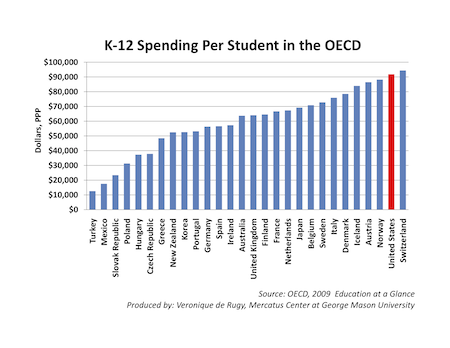
Having taught once upon a time myself, I am well aware of how difficult a job it is, and I have nothing but respect for folks who choose teaching as a vocation; however, the teachers union has about as little to say on education policy as the politicians who oppose them. Policymakers have little to no idea what works in the classroom, and the union appears unable to grasp the fundamentals of fiscal sustainability. Probably, the best that can be done by the taxpayer at this time is to make education policy as local as possible and to enable parents as much choice as possible so that those who care can escape a bad situation and make choices for themselves based on what they feel is best for their children.


No comments:
Post a Comment